
Certificate Course in Maritime Catering CCMC
Course Duration
06 Months
Category
Pre Sea Course
Intake
40 students (Jan & July)
Course Fees
₹ 2,25,000/-
About The Programme
The Certificate Course in Maritime Catering (CCMC) is one of India’s most accessible and rewarding entry points into the global Merchant Navy — designed specifically for candidates who wish to build a career in the Catering and Hospitality Department aboard commercial vessels, cruise liners, and offshore platforms. Approved by the Directorate General of Shipping (DGS), Government of India, the CCMC is a 6-month pre-sea training programme that prepares candidates for catering roles onboard ships, with training in food production, bakery, galley operations, housekeeping, hygiene, and basic seamanship.
What makes the CCMC uniquely compelling is its accessibility. Unlike deck or engine courses, the CCMC does not require PCM subjects, making it accessible to a wider group of students. Whether you come from a Science, Commerce, or Arts background — if you have a passion for hospitality, culinary arts, and a desire to see the world, this programme is built for you.
Saloon Ratings trained through the CCMC programme are equipped in Food Production, Food & Beverage Service, and Housekeeping services, and can be employed in either the Main Fleet of the Merchant Navy or Cruise Shipping, carrying out all operations in hospitality management.
At Asha Marine Technical College & Research (AMTCR), Pali, Mumbai, the CCMC programme is delivered with the same rigour, discipline, and international compliance that defines everything we do. Located in Mumbai — India’s maritime capital — our campus gives CCMC cadets direct exposure to the maritime world from day one, preparing them not just for their first posting, but for a lifetime of global opportunity.
Eligibility Criteria
Educational Qualification
Candidates must have passed the 10th Standard from a recognised board with a minimum of 40% aggregate marks and a minimum of 40% marks in English in the 10th standard.
Additionally, the following candidates are also eligible:
– Candidates who have passed the 12th Standard from any recognised board (Science, Commerce, or Arts stream) with a minimum of 40% aggregate and 40% in English
– Candidates holding a Degree or Diploma in Hotel Management from a recognised and reputed board or university, with 40% marks in English in 10th or 10+2
– Candidates with an ITI qualification in relevant trades from a DVET or NCVT-approved institution
Age Requirement
- General:17½to 25years on the date of coursecommencement
- OBC:Up to 28years (3 years extension)
- SC/ST:Upto 32years (5 years extension)
Medical & Physical Fitness
Candidates must be medically and physically fit. A full medical check-up through a panel doctor approved by DG Shipping will be undertaken, and a complete eyesight test will also be conducted in which the distance vision should be 6/6 with no colour blindness.
Additional requirements include:
– A Medical Fitness Certificate issued by a DG Shipping-approved doctor is mandatory prior to admission
– No hearing impairments or physical disabilities that would affect the performance of shipboard duties
– Good overall physical health with no serious medical conditions
– A valid Indian Passport (or passport application in process at time of admission)
Note: Medical fitness must be confirmed prior to enrolment. A list of DG Shipping-approved doctors can be accessed at www.dgshipping.gov.in.
Required Documents
- 10thpass original mark sheet
- Passport(Pages 1, 2, 3)
- Passport-sizephoto (3.5cm x 3.5cm) with 75% face coverage, plaincolor shirt, white background
- Signature on a whitepage with Blue ball pen (as per passport)
Programme Structure & Syllabus
The CCMC programme at AMTCR Pali Mumbai is structured to give cadets a thorough, practical, and internationally compliant training experience across all areas of shipboard catering and hospitality. The curriculum balances culinary expertise, hospitality service, maritime safety, and personal development — producing graduates who are truly ship-ready from day one.
Module 1 — Food Production & Galley Operations
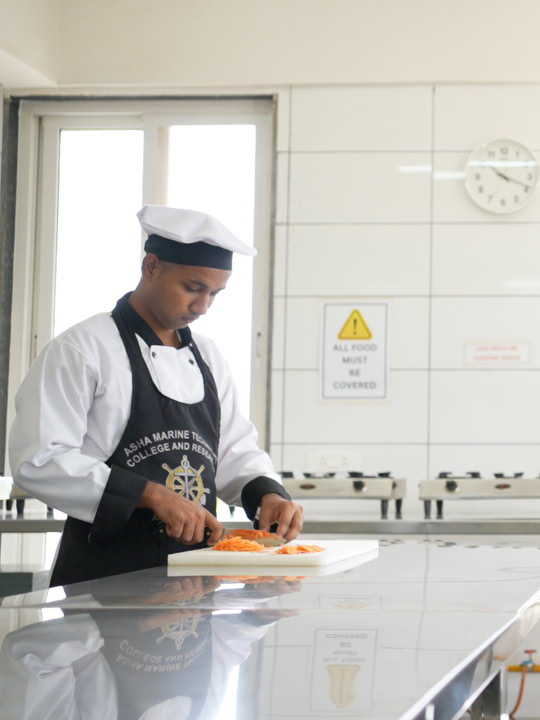
The heart of the CCMC programme. Cadets receive comprehensive training in food production techniques, menu planning, nutritional cooking, and galley (ship’s kitchen) operations. They learn to prepare meals for international, multicultural crews — understanding dietary requirements, cultural preferences, and the nutritional demands of personnel working in physically demanding maritime environments. Practical galley training at AMTCR ensures that every CCMC graduate can operate confidently and efficiently in a ship’s kitchen from their very first day at sea.
Module 2 — Bakery & Confectionery
A dedicated module covering bread making, pastry, confectionery, and dessert preparation — essential skills for catering crew aboard vessels where the galley team is responsible for all meals and refreshments, around the clock, seven days a week. Cadets develop both the technical skills and the consistency required to maintain high food standards across long voyages.
Module 3 — Food & Beverage Service
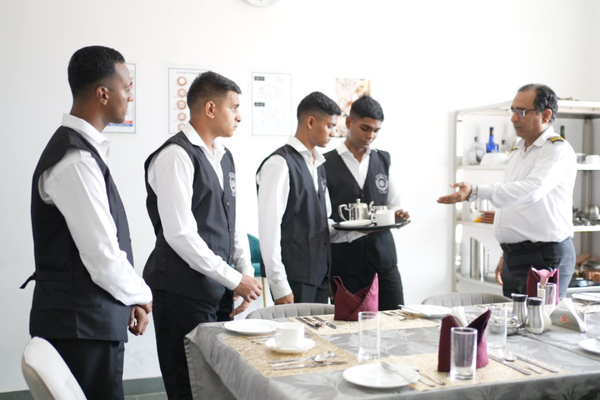
Cadets are trained in housekeeping, service protocols, and hospitality management. This module covers food and beverage service standards, table setting, mess management, crew dining protocols, and the hospitality practices expected aboard international vessels — particularly relevant for those seeking placements on cruise liners or passenger ships where service standards are exceptionally high.
Module 4 — Housekeeping & Hygiene
Shipboard housekeeping is a critical responsibility — a clean, well-maintained vessel directly impacts crew health, morale, and safety. This module covers cabin and common area maintenance, linen management, sanitation procedures, waste management, and the hygiene standards mandated by international maritime health regulations.
Module 5 — Maritime English & Communication
English is the working language of the international maritime industry. This module equips cadets with the maritime vocabulary, communication skills, and documentation knowledge required to function effectively aboard vessels crewed by personnel from across the globe. Clear communication at sea is not merely a professional courtesy — it is a safety imperative.
Module 6 — Basic Seamanship & Ship Familiarisation
Cadets are also trained in basic seamanship, ensuring they understand the structure and operations of a commercial vessel beyond the galley and service areas. This module covers ship terminology, the layout of vessel departments, emergency procedures, muster drills, and the basic safety responsibilities shared by every person aboard a ship — regardless of their department.
Module 7 — STCW Basic Safety Certification
Cadets are trained in STCW safety courses including firefighting, survival techniques, and first aid. The STCW Basic Safety modules covered include:
– Personal Survival Techniques (PST)
– Fire Prevention and Firefighting (FPFF)
– Elementary First Aid (EFA)
– Personal Safety and Social Responsibilities (PSSR)
– Security Training for Seafarers with Designated Security Duties
These internationally recognised certifications are compulsory for joining any merchant vessel anywhere in the world and are fully integrated into the AMTCR CCMC programme.
Module 8 — Physical Training & Drills
Life at sea demands physical resilience and mental discipline. Physical training, swimming, emergency evacuation drills, and lifesaving appliance training are integral components of the CCMC programme at AMTCR — ensuring every graduate is physically capable and mentally prepared for the unique demands of life aboard a commercial vessel.
Scope of the Programme
- The CCMC opens doors that very few other maritime courses can match in terms of breadth, accessibility, and global reach. Once candidates have completed the Certificate Course in Maritime Catering, graduates can be placed aboard merchant navy vessels, offshore rigs, and international cruise lines.
- The catering department plays a crucial role onboard ships, ensuring crew welfare, nutrition, and hygiene. With increasing crew sizes and strict food safety standards, skilled maritime cooks are always in demand. CCMC also opens doors to cruise ships, offshore vessels, and luxury liners, offering global exposure, tax-free earnings while sailing, and opportunities to work in international environments.
- Merchant Cargo Vessels — Bulk carriers, container ships, tankers, and general cargo vessels all employ dedicated catering crew to feed and service their international crews on long voyages.
- Cruise Liners & Passenger Ships — Among the most prestigious and competitive postings available to CCMC graduates. Cruise liners operate to the highest hospitality standards in the world and offer exceptional career growth, international exposure, and earning potential for outstanding catering professionals.
- Offshore Platforms & Supply Vessels — The offshore oil and gas industry employs large numbers of catering crew aboard drilling platforms, FPSO vessels, and offshore support ships — offering competitive salaries and regular rotation schedules.
- Indian Coastal Shipping — A growing segment of India’s maritime sector that provides CCMC graduates with early career sea service opportunities close to home.
Certificates Awarded on Completion
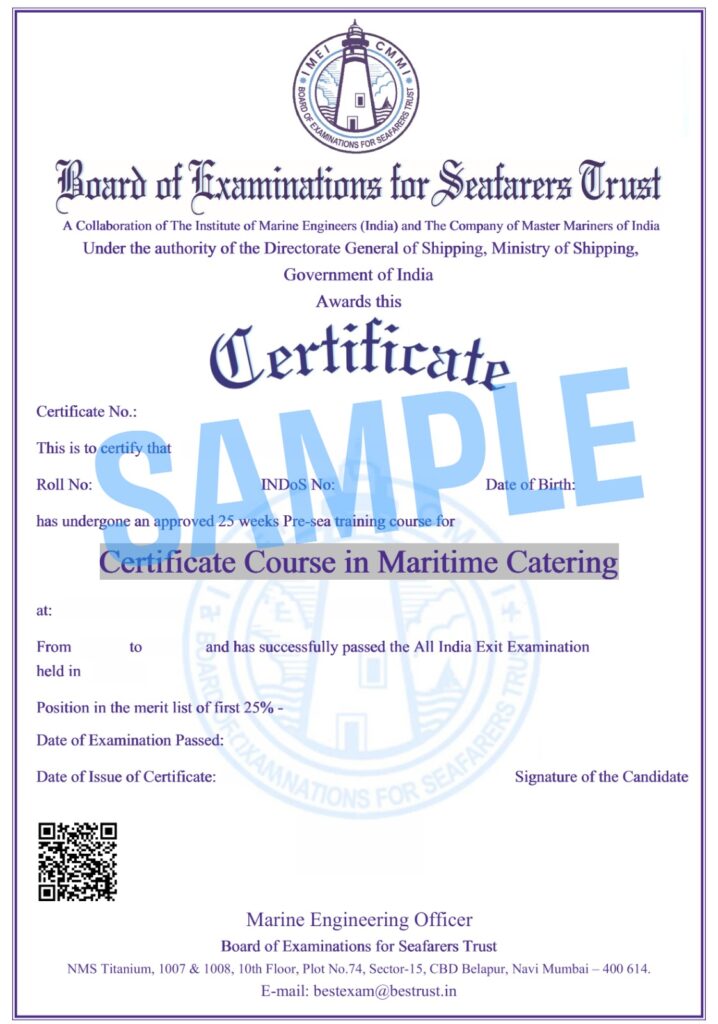
Upon successful completion of the training and passing the All India Exit Examination, cadets are awarded the following certificates:
- CCMC Completion Certificate
- All India CCMC Examination Passing Certificate (issued by BEST)
- Basic Safety Training Certificates (PST, PSSR, EFA, FPFF)
- Security Training Certificate
- Indian National Database of Seafarers (INDOS) Registration
- Continuous Discharge Certificate (CDC)
Career Growth Path
Stage
On Joining
After 1–2 Years
After 3–5 Years
Senior Level
Top Level
Position
Trainee Cook or General Steward / Messman
Assistant Cook / Second Cook / Steward
Ship's Cook / General Steward
Chief Cook / Catering Officer
Chief Catering Officer (Cruise / Passenger Ships)
Placement Opportunities
Direct Industry Access
Strong relationships with Indian and international shipping companies, crewing agencies, and maritime employers create direct pathways into commercial shipping careers.
Campus Placement Drives
| Shipping companies and crewing agencies regularly visit the campus to recruit directly from graduating batches, providing immediate employment opportunities. |
CDC & INDOS Registration Support
Comprehensive assistance for obtaining CDC and INDOS registration, ensuring graduates are ready for professional seafaring employment.
Crewing Agency Tie-Ups
Connections with leading crewing agencies placing catering personnel on Indian and foreign-flag vessels, including cargo ships, tankers, offshore vessels, and cruise liners.
Cruise Line Placement Pathways
Guidance and support for progression into premium cruise ship careers after gaining initial sea-going experience and demonstrating strong performance.
Alumni Network
Access to a global network of alumni serving aboard vessels worldwide, providing mentorship, guidance, and career opportunities.