
Electro Technical Officer ETO
Course Duration
04 Months
Category
Pre Sea Course
Intake
40 students (Jan, May & Sept)
Course Fees
₹2,50,000/-
About The Programme
The Electro-Technical Officer (ETO) Programme is one of the most technically specialised and strategically important officer-level courses in the Indian maritime sector — and one of the most in-demand qualifications in the global Merchant Navy today. Approved by the Directorate General of Shipping (DGS), Ministry of Shipping, Government of India, and aligned with the STCW Convention amendments of 2010 adopted by the International Maritime Organization (IMO), the ETO programme is designed specifically for Electrical and Electronics Engineering graduates and diploma holders who wish to transition from land-based engineering into a high-responsibility, high-reward career at sea.
The Electro-Technical Officer is a licensed member of a merchant ship’s engine department, responsible for monitoring sensors and alarm systems. They are on call 24 hours a day, working a daily shift on electrical and electronic maintenance, repairs, diagnosis, installations, and testing.
Electro-Technical Officers are accountable for checking all electronic and electrical equipment on a ship to ensure operational safety and competency.
In short, the ETO is the technical backbone of a modern vessel — the officer who ensures that the ship’s complex, interconnected electrical and electronic systems never fail, and when issues arise, resolves them swiftly and safely.
Eligibility Criteria
Educational Qualification
Candidates must obtain a minimum of 60% marks in a three-year diploma programme, or a minimum of 50% marks in a four-year degree programme including lateral entry, in the fields of Electrical Engineering, Electronics Engineering, Electrical and Electronic Engineering, Electronics and Communication Engineering, Electronics and Telecommunication, Electronics and Instrumentation, or an equivalent discipline.
Candidates must also pass Physics, Chemistry, and Mathematics at the 10+2 level and have a minimum of 50% marks in English in the 10th or 12th standard examinations.
Age Requirement
As per new DG circular Age criteria for General should be 17.5 yrs. to 25 yrs. & for SCST age should be 17.5yrs to 32 yrs.
Medical & Physical Fitness
Candidates must be physically fit and meet the medical requirements as specified by DGS guidelines.
- Medical Fitness Certificate issued by a DG Shipping-approved doctor — mandatory prior to admission
- Good eyesight meeting DG Shipping maritime medical standards
- No hearing impairments or physical disabilities affecting the performance of shipboard duties
- Good overall physical health with no serious medical conditions
- A valid Indian Passport (or passport application in process at time of admission)
Medical fitness must be confirmed prior to enrolment. A list of DG Shipping-approved doctors is available at www.dgshipping.gov.in.
Required Documents
- 10th Pass Original Mark sheet
- Scan Copy Passport (Page 1, 2, 3)
- Passport Size Photograph with White Background Plain Colour Shirt (No Checks/Dots) Size: 3.5 cm x 3.5 cm (75% face visible)
- Signature on white paper with black ball pen (as per passport
Programme Structure & Syllabus
The ETO programme at Asha Marine Technical College & Research (AMTCR), Pali, Mumbai is structured around the DGS-approved curriculum aligned with STCW 2010 Convention requirements, combining rigorous theoretical instruction with extensive practical laboratory and simulator training. The ETO course syllabus is officially approved by DG Shipping, Government of India, and aligns with STCW Convention IMO requirements, ensuring comprehensive training in both theoretical and practical aspects required for modern shipboard electrical and electronic systems.
Module 1 — Marine Electrical Systems & Power Generation
This foundational module covers the fundamentals of marine electrical systems and power distribution, as well as high-voltage installations, switchboards, and protection systems. Cadets develop a thorough understanding of shipboard power generation — including main generators, emergency generators, and uninterruptible power systems — and the distribution networks that keep every system aboard a vessel running safely and efficiently.
Module 2 — Engine Room Automation & Control Engineering
Cadets are trained in engine room automation and Programmable Logic Controllers (PLCs), covering the integrated automation systems that govern the operation of modern commercial vessels. This module includes hands-on training with alarm monitoring systems, automated control panels, and the diagnostic tools used to identify and resolve system faults at sea.
Module 3 — Navigation & Communication Electronics
Navigation and communication electronics training covers radar, ECDIS, GPS, and AIS systems. Cadets learn to operate, maintain, and troubleshoot the navigation and communication equipment that modern vessels depend on for safe passage — from integrated bridge systems and satellite communication equipment to GMDSS installations and VHF radio systems.
Module 4 — Safety Systems & Emergency Power
This module covers fire detection, alarm systems and safety circuits, battery systems, emergency power, and emergency lighting. ETOs bear primary responsibility for the integrity of a vessel’s safety-critical electrical systems, and this module ensures every AMTCR graduate is fully prepared to manage, test, and respond to safety system failures with confidence and competence.
Module 5 — High Voltage Safety & Switchgear
A specialist module covering the theory and practice of high-voltage electrical systems aboard commercial vessels. Cadets are trained in safe working procedures, risk assessment, permit-to-work systems, and the maintenance of high-voltage switchgear — a critical competency for ETOs serving aboard large tankers, bulk carriers, and LNG vessels.
Module 6 — Marine Electronics & Instrumentation
A specialist module covering the theory and practice of high-voltage electrical systems aboard commercial vessels. Cadets are trained in safe working procedures, risk assessment, permit-to-work systems, and the maintenance of high-voltage switchgear — a critical competency for ETOs serving aboard large tankers, bulk carriers, and LNG vessels.
Module 7 — Practical Laboratory & Simulator Training
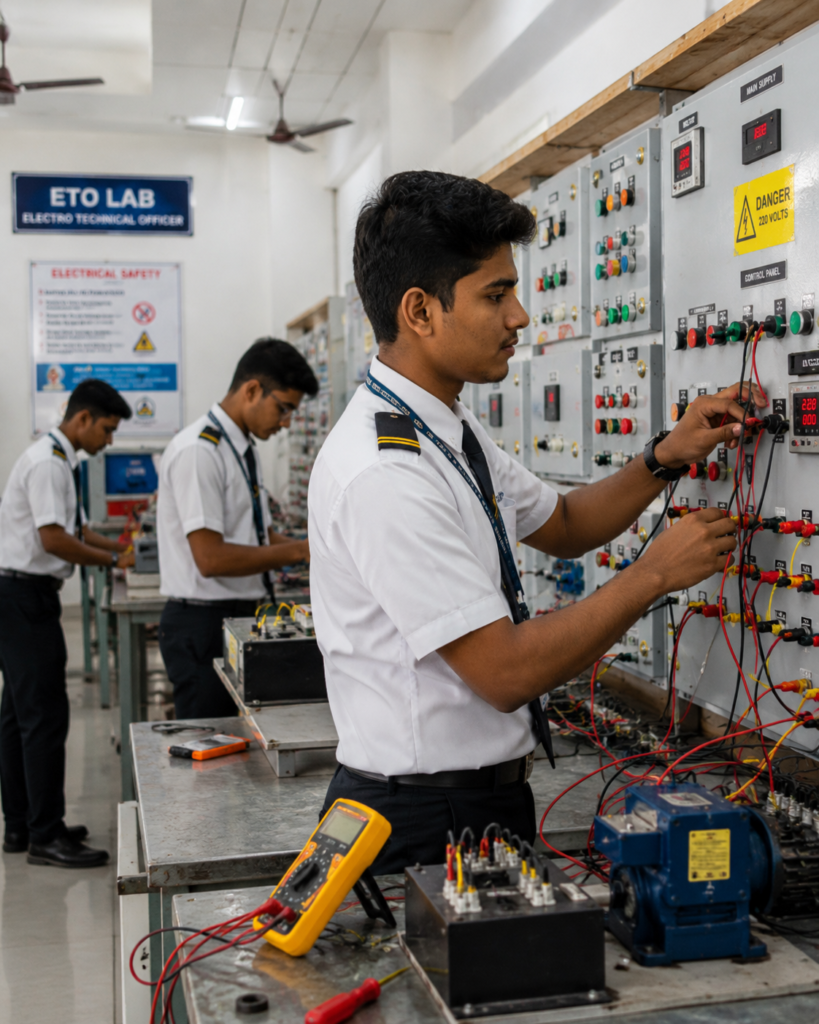
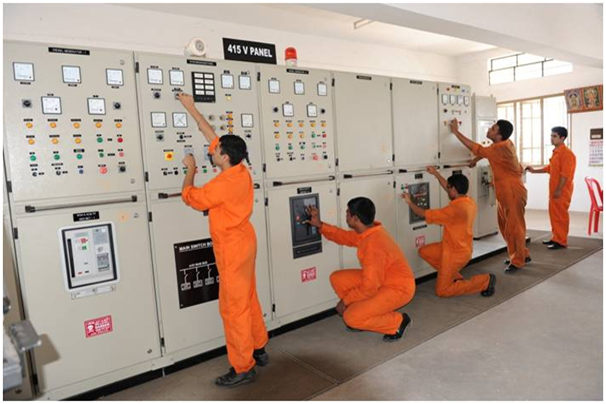
Extensive lab sessions and simulations help students become proficient in troubleshooting live systems — essential for real-world shipboard responsibilities. At AMTCR Pali Mumbai, cadets have access to dedicated electrical engineering laboratories and simulation facilities, where they practise fault diagnosis, system repair, and preventive maintenance in a safe and controlled environment before stepping aboard their first vessel.
Module 8 — STCW Basic Safety Certification
- Personal Survival Techniques (PST)
- Fire Prevention and Fire Fighting (FPFF)
- Elementary First Aid (EFA)
- Personal Safety and Social Responsibilities (PSSR)
- Security Training for Seafarers with Designated Security Duties
These internationally recognized certifications are mandatory for joining merchant vessels worldwide.
Module 9 — Maritime Law, Ship Management & Safety Culture
An essential professional development module covering the legal framework governing seafarers’ rights and responsibilities, the Safety Management System (SMS) requirements of the ISM Code, MARPOL environmental regulations, MLC 2006 conventions, and the professional ethics and conduct expected of an officer aboard a commercial vessel.
Scope of the Programme
- The ETO qualification opens doors across the full spectrum of the global maritime and offshore industry. Ship types that employ ETOs include container ships, LNG carriers, offshore platforms, cruise liners, and research vessels.
- With ships increasingly relying on advanced electrical and electronic systems, ETOs have become indispensable on modern vessels. The growth of automation, digitisation, and smart ship technology across the global fleet means that the demand for qualified, competent ETOs is not just steady — it is growing year on year.
- Beyond shipboard roles, the ETO qualification commands respect and recognition in the wider maritime industry:
Technical Superintendent Roles — Experienced ETOs are highly sought after for shore-based technical management positions with shipping companies, managing the electrical and electronic maintenance programmes across entire fleets. - Maritime Training & Education — Senior ETOs transition naturally into roles as maritime training instructors and course developers, contributing to the next generation of shipboard officers.
- Shipyard & OEM Service Roles — The technical expertise of a serving ETO is highly valued by shipyards, marine equipment manufacturers, and original equipment service organisations.
- Port Authority & Marine Consultancy — The combination of officer-level certification and deep technical expertise qualifies ETOs for a range of regulatory, inspectorate, and consultancy roles within India’s port and maritime infrastructure.
Certificates Awarded on Completion
Upon successful completion of pre-sea training and passing all assessments at AMTCR Pali Mumbai, cadets are awarded:
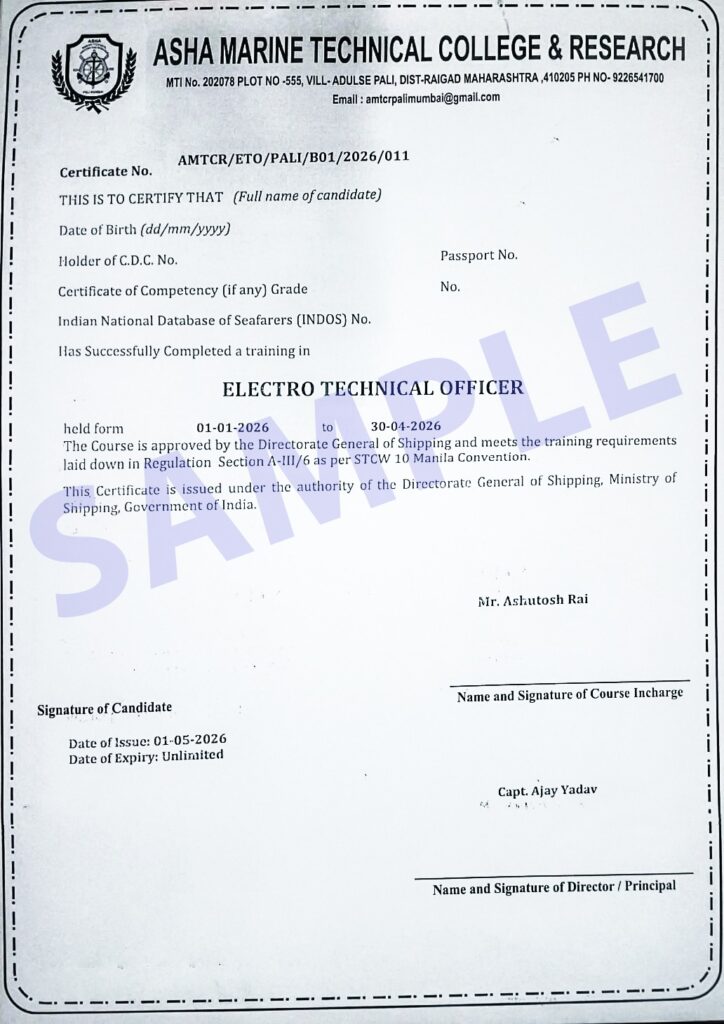
- ETO Pre-Sea Course Completion Certificate — issued by AMTCR, approved by DG Shipping
- STCW Basic Safety Training Certificates (PST, FPFF, EFA, PSSR)
- INDOS Registration — Indian National Database of Seafarers
- Continuous Discharge Certificate (CDC) — the internationally recognised seafarer identity and service record document
Following the completion of structured sea service, candidates become eligible to appear for the ETO Certificate of Competency (COC) examination conducted by the Directorate General of Shipping, Government of India — the ultimate professional qualification for a serving ETO.
Career Growth Path
Stage
On Joining
After COC Certification
Senior Level
Shore-Based / Management
Position
Trainee ETO / Junior ETO
Electro-Technical Officer (ETO)
Senior ETO / Chief Electrical Officer
Technical Superintendent / Marine Consultant
Placement Opportunities
Direct Industry Access
Established relationships with Indian and international shipping companies create direct employment pathways.
Campus Placement Drives
Leading shipping companies and crewing agencies regularly recruit ETO graduates directly from campus.
CDC & COC Examination Support
Comprehensive support for CDC registration and DGS COC examination preparation.
Sponsorship Programme Pathways
Assistance in connecting eligible cadets with sponsored ETO training opportunities.
Educational Loan Assistance
Guidance and documentation support for educational loan applications.
Alumni Network
Access to a growing network of ETO alumni providing mentorship and career guidance.